



Water is what most drywall jobs start with
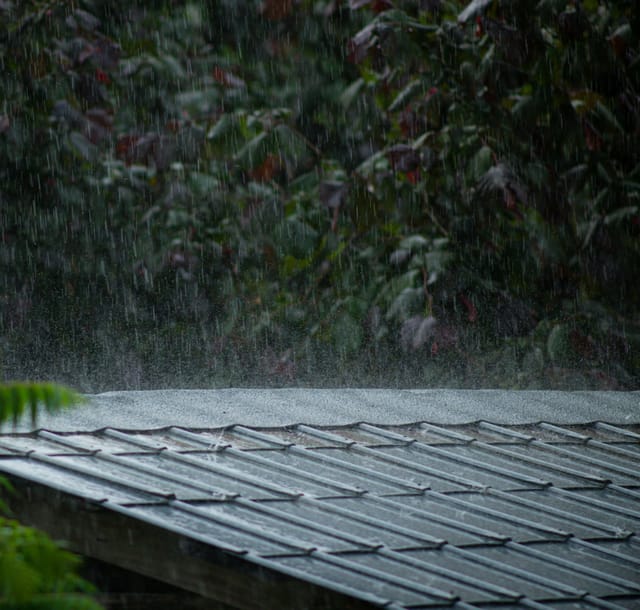
Standard drywall is a gypsum core faced with paper, and paper and water don't mix. In a coastal region with hurricane rain, wind-driven rain and low ground, a lot of drywall work begins with a leak: a roof that lets water into a ceiling, a window that lets rain into a wall, a bathroom without enough ventilation, or water across the floor after a storm.
FEMA's Technical Bulletin 2 rates building materials by whether they can stand up to at least 72 hours of contact with floodwater without needing more than cosmetic repair. Paper-faced gypsum board, greenboard and plaster are rated unacceptable by that test, while non-paper-faced gypsum board and water-resistant, fiber-reinforced gypsum sheathing are rated acceptable. For rooms below a home's flood elevation, that difference decides what goes back on the wall after a flood. In a bathroom, the EPA's advice is to keep indoor humidity below 60 percent, ideally between 30 and 50, and to run the fan or open a window when showering, so a repaired ceiling doesn't go the same way as the old one.
How much has to come out after a leak
The EPA's advice is to dry water-damaged materials within 24 to 48 hours; after that, mold usually starts to grow. Porous materials such as ceiling tiles and carpet may have to be thrown away once they're moldy, because mold fills the empty spaces and crevices and can be impossible to remove completely, and wet drywall is handled the same way: cut out, dried behind, replaced. If the moldy area is bigger than about 10 square feet, roughly a 3 by 3 foot patch, the EPA points to its guide for professional cleanup instead of a do-it-yourself job.
Painting over a stain doesn't fix it. The EPA says not to paint or caulk moldy surfaces, but to clean up the mold and dry the surfaces first, because paint applied over mold is likely to peel. And a stain always has a source. Before we cut anything, we trace the water back to it, whether that is a roof, a window, a pipe or a shower, because a new ceiling under an old leak will stain again.
Finish levels and why some walls look smoother
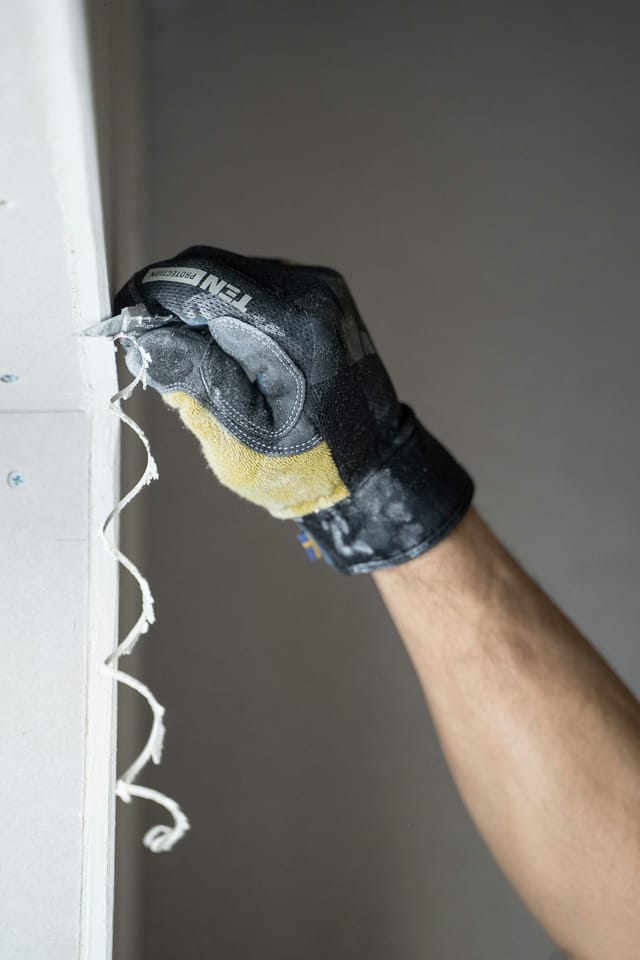
The Gypsum Association's GA-214 standard sets out levels of finish from 0 to 5, and the right one depends on the paint and the light. Level 3, with tape, a separate coat over the joints and two coats over the fasteners, suits walls that get a heavy or medium texture. Level 4 adds another coat over the flat joints and a third over the fasteners, and it is typical for smooth walls in flat paint or light texture, but it isn't recommended for non-flat or dark, deep-tone paints. Level 5 adds a skim coat over the entire surface. It is specified for glossy or dark paint and where critical lighting conditions occur, such as sun raking across a wall from a big window, because it keeps joints and fasteners from showing through. A patch has to match the finish around it, or it shows as soon as the paint dries.
Permits for drywall work
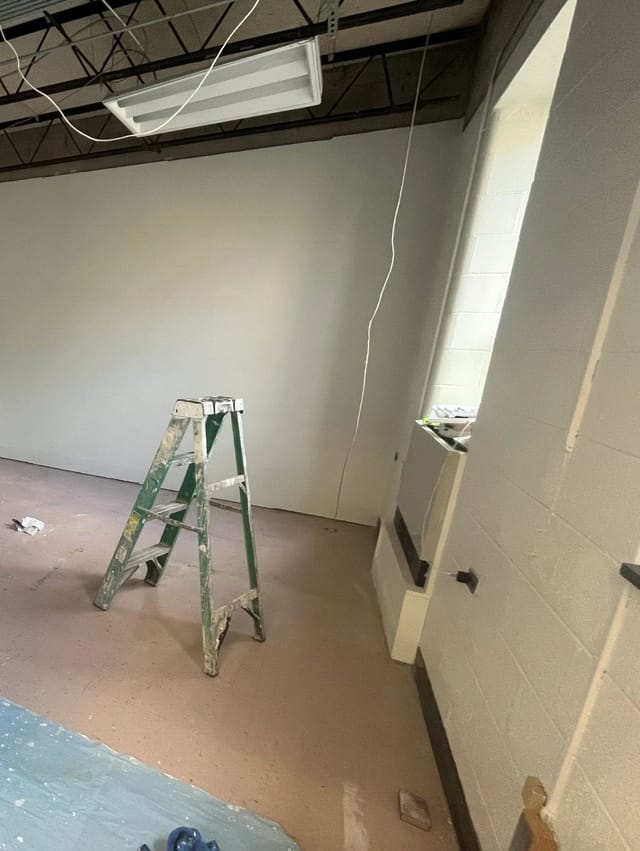
Virginia's building code lists the replacement of interior wall and ceiling finishes in houses among the ordinary repairs that need no permit, but each city applies the code its own way. Norfolk's permit guidance says that for residential projects, building permits are required to remove drywall, construct new partition or bearing walls, relocate walls or install new framing. So in Norfolk, a job that opens walls starts with a permit, and we check with the city before the old board comes out.
What moves the price
A small patch and a whole ceiling are different jobs. The price moves with the size and number of repairs, walls or ceilings, the height of the room, texture matching, the finish level, how far the paint has to go to blend in, and whether the cause, such as a roof or window leak, has to be fixed first. Water damage adds drying time and, where there's mold, careful removal.
Sources
- FEMA Technical Bulletin 2: Flood damage-resistant materials requirements (2025)
- EPA: A brief guide to mold, moisture and your home
- EPA: Mold cleanup in your home
- National Gypsum: Five levels of gypsum board finish (GA-214)
- Virginia Administrative Code 13VAC5-63-80: USBC section 108, permits
- City of Norfolk: Permit questions
- BBB: Stormy Services, LLC customer review by Jared B
- Stormy Services old website (testimonials)
- Stormy Services intake (2026-11-23)


