



A leak leaves the same mark whether it came through the roof in a storm or from a pipe in the wall: a stain on the ceiling, a bubble in the paint, a soft spot at the bottom of a wall. The drywall behind it decides how big the repair gets. Some wet board can be dried and kept. Some has to be cut out. The clock starts the moment the water does.
Stop the source first
There is no point drying a wall that is still getting wet. EPA's moisture guide puts it first: fix plumbing leaks and other water problems as soon as possible, then dry everything completely. For a roof leak that means a tarp or a roof repair before anything inside. For a pipe, the water gets shut off and the line repaired. Condensation counts too: water collecting on windows, walls or pipes is a sign of high humidity, and EPA's answer is more ventilation and less moisture.
The 24 to 48 hour window
EPA's rule of thumb is the most useful thing to know after a leak. If wet materials are dried within 24 to 48 hours, in most cases mold will not grow. Things that stay wet for more than two days usually do get moldy.
Drywall is paper on both faces with gypsum in between, and the back side is where trouble hides. EPA lists the back of drywall, the top of ceiling tiles and the underside of carpet among the places hidden mold grows. A wall that looks dry from the room can still be wet in the cavity behind it, against the insulation. That is why drying means air moving across the wall and, often, a hole cut to get air inside.
When wet board has to come out
A few situations almost always mean cutting the board out.
- It has grown mold. EPA says absorbent or porous materials may have to be thrown away if they go moldy, because mold fills the empty spaces in them and can be hard or impossible to remove completely. If mold covers more than about 10 square feet, EPA points to its guidance for larger cleanups.
- The water was dirty. If the water came from sewage or another contaminated source, EPA says to bring in professionals experienced in cleaning up after contaminated water.
- It sat in flood water. FEMA's guidance on flood damage-resistant materials defines prolonged contact as at least 72 hours. It rates paper-faced gypsum board, greenboard and plaster as unacceptable for use below the base flood elevation in flood zones, while non-paper-faced gypsum board and water-resistant, fiber-reinforced gypsum sheathing are acceptable. In a flood-prone room, that is worth knowing before the new board goes up.
- It sagged or crumbled. A ceiling that bowed under water, or board that has gone soft, comes out.
Permits for the repair
In Norfolk, cutting out drywall is permitted work. The city's permit FAQ says building permits are required to remove drywall in homes, along with building or moving walls and new framing. Virginia Beach's residential permit page likewise lists cutting away any wall or partition among work that needs a permit. Painting, on the other hand, needs no permit under Virginia's building code, which lists the application of paint or wallpaper as an ordinary repair. Plan the permit into the schedule so it doesn't hold up the patch.
Matching the finish
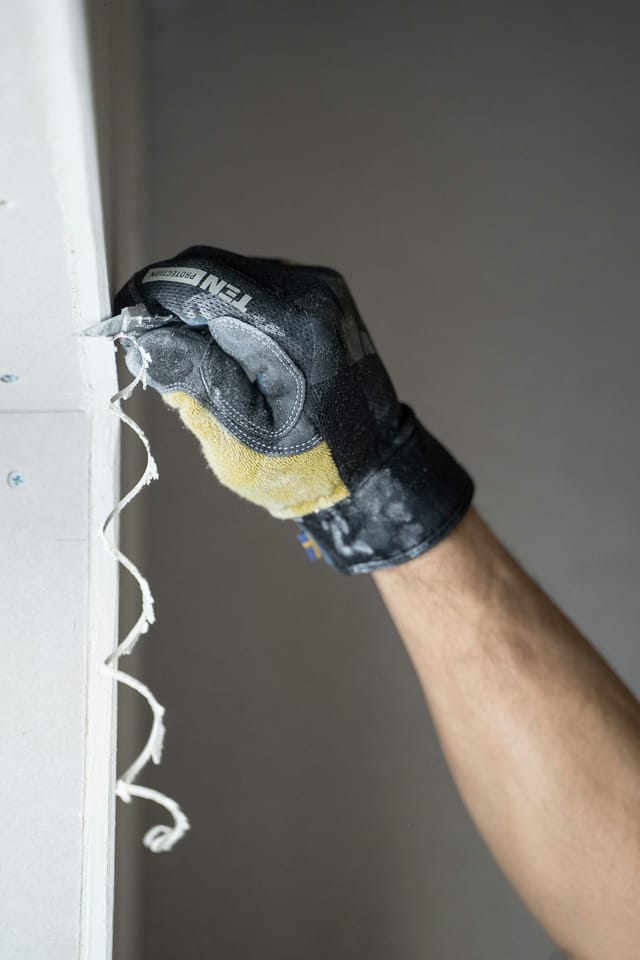
A good drywall repair disappears under paint, and that depends on the level of finish. The industry standard is the Gypsum Association's GA-214, which describes levels of finish from 0 to 5.
- Level 4 is typical where smooth walls get flat paint, light textures or wallcovering. Joints get tape and two coats of compound, inside corners one more coat, and fastener heads three coats. It is not recommended under glossy or dark paint.
- Level 5 adds a skim coat over the whole surface. It is the level for glossy or decorative finishes, dark colors, or walls where light rakes across the surface, because it keeps joints and fasteners from showing through.
A patch finished to a lower level than the wall around it will show, especially on a ceiling or a hallway wall lit from the side. Matching the existing texture and the level of finish, then priming and painting the whole wall or ceiling plane, is what makes a repair blend in.
What we do after a leak
We stop the water, dry what can be dried, cut out what can't be saved, then hang, finish and paint the patch so it matches the wall around it. We do both drywall and painting, so the patch and the paint come from the same crew. Call or text (757) 957-3340 at any hour for a leak, or for a free quote on the repair.
Sources
- A brief guide to mold, moisture and your home U.S. Environmental Protection Agency.
- Mold cleanup in your home U.S. Environmental Protection Agency.
- Resources for flood cleanup and indoor air quality U.S. Environmental Protection Agency.
- Technical Bulletin 2: Flood damage-resistant materials requirements (2025) Federal Emergency Management Agency.
- Permits: frequently asked questions City of Norfolk.
- Residential building permits City of Virginia Beach.
- 13VAC5-63-80, Virginia Uniform Statewide Building Code, Section 108 Application for permit Virginia Administrative Code.
- Discover five levels of gypsum board finish National Gypsum, on the Gypsum Association's GA-214.
Every home is different. Talk to us about yours before you decide; nothing here replaces a look at the job.


